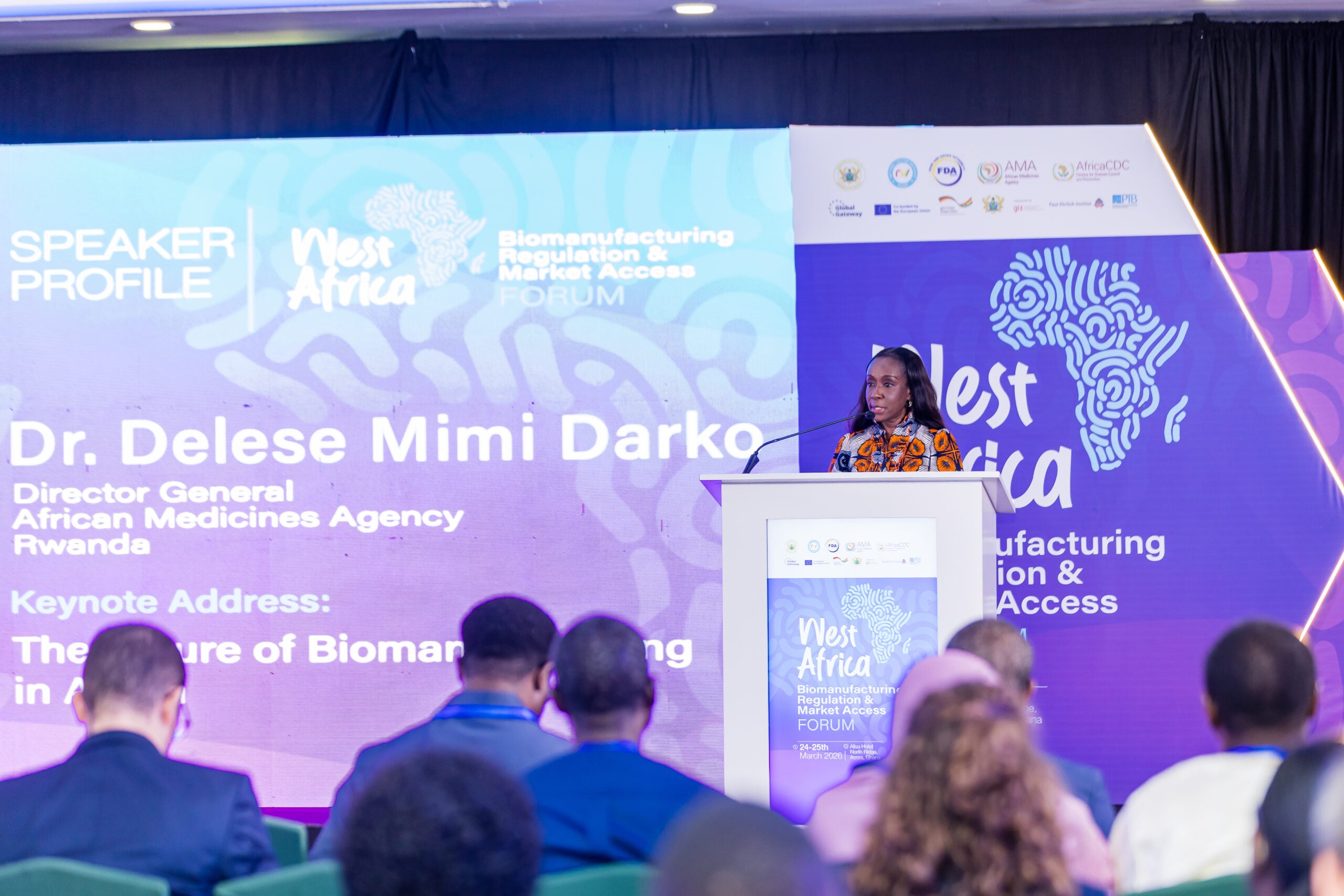
In her keynote address on “Regulatory Innovation and the Future of Biomanufacturing in Africa – The Future with AMA”, H.E. Dr Delese Mimi Darko, Director-General of the African Medicines Agency (AMA), underscored the urgent need to align Africa’s manufacturing ambition with strong, coordinated regulatory systems.
“Africa carries about 25% of the global disease burden, yet produces less than 1% of the vaccines it uses. And even when products reach our markets, they face fragmented regulatory pathways.”
She emphasised that while the continent is committed to expanding biomanufacturing, success will depend on how effectively systems are designed and connected:
“Biomanufacturing does not fail at the level of science. It fails at the level of systems.”
Highlighting the role of AMA, she noted that the Agency is not replacing national systems, but strengthening and connecting them:
“AMA does not replace National Regulatory Authorities. It brings them together into a coordinated, reliance-based system, where expertise is shared, and decisions can be relied upon across countries.”
This shift translates into tangible benefits:
“For industry, this means one entry point, a coordinated scientific assessment, and access to multiple markets.”
She also introduced AMA’s SME and Innovation Office as a critical enabler of Africa’s biomanufacturing future:
“Innovation in Africa does not fail because of weak science; it often fails because the systems are fragmented and difficult to navigate. Our SME and Innovation Office is designed to change that, providing early scientific advice, regulatory guidance, and a clear pathway from development to market”
On safety and trust, she was clear:
“Faster access does not mean lowering standards. We remove duplication, not rigour. We take away delay, not safety.”
She further emphasised the importance of coordinated systems:
“Fragmented support risks reproducing the very inefficiencies we are trying to solve. AMA provides a platform for alignment under a single continental strategy.”
Concluding, she reinforced the need for collective action:
“Africa’s future will be defined not just by ambition, but by whether we build systems that work, for regulators, for industry, and most importantly, for patients.”
Authors:
Communications Division
